
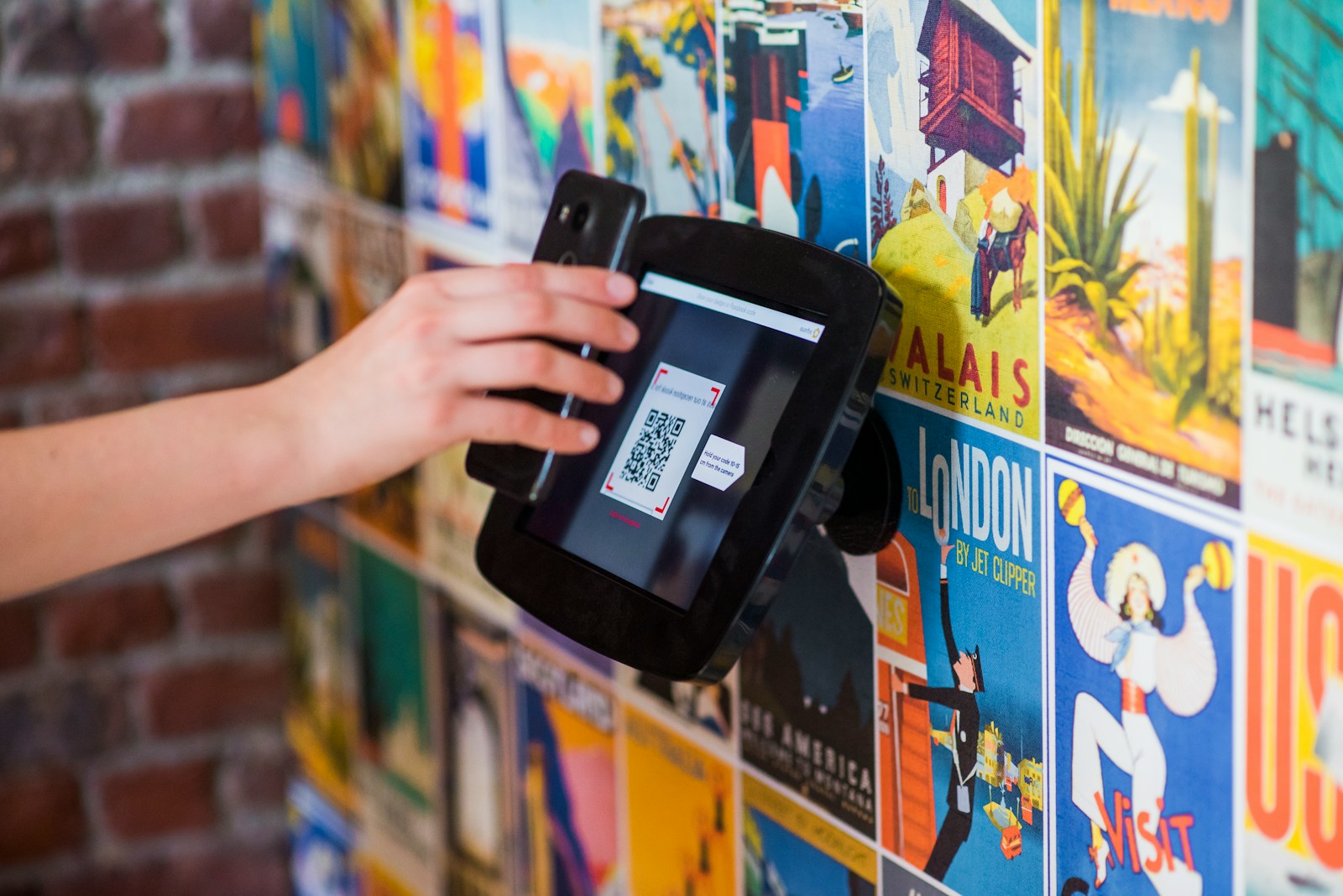
The story of QR codes and their scanners is one of technological evolution, shifting business models, and the interplay between hardware, software, and mobile devices. Although the code itself was invented in the 1990s, the era of free QR code scanner apps is more recent. In this essay I’ll trace the origin of the QR code, the early scanning tools, how “free scanner apps” emerged, and how the landscape looks today.
Origins of the QR Code
The basic technology that enables QR codes underpins the story of free scanners. The two‐dimensional “quick‐response” (QR) code was developed in 1994 by Denso Wave (a subsidiary of the Toyota Group) in Japan.
The purpose: automotive parts tracking and manufacturing logistics, where traditional bar‐codes (UPC, etc) were proving insufficient—too small capacity, too slow to scan from odd angles, etc.
The code’s design incorporated patterns that would allow fast detection by cameras (rather than the single‐line beam of older bar-codes) and robust orientation insensitivity. Over time, the QR code standard (ISO 18004) was formalized and the code began to appear broadly beyond its industrial origins.
Early Scanning Tools and the Mobile Shift
Having the QR code itself is only half the story; one needs the ability to scan/interpret it. In the early years, QR codes were generally scanned by specialized industrial equipment or optical readers. But as smartphones became more widely available, their cameras and processing power enabled the possibility of consumer‐level QR scanning.
Sources indicate that while QR codes were invented in 1994, their popularity on mobile devices began around the early 2000s. For example, one history site says: “While QR codes were invented in 1994, they only started becoming popular in 2002. This was due to QR code scanner apps being released alongside mobile phones.”
Thus, as mobile operating systems (iOS, Android, etc) matured, developers began shipping dedicated QR‐scanner apps (often free to download) which let users point their phone camera at a QR code and have it decoded to a URL, text, contact info, etc.
Emergence of Free QR Code Scanner Apps
With smartphones in hand and cameras ubiquitous, it became straightforward for third‐party developers to create “free” QR code scanning apps. These apps often monetised in other ways (ads, in‐app purchases, premium features) but the core scanning functionality was offered at no cost.
Some key points in this phase:
- Free apps lowered the entry barrier for scanning; users did not need special hardware.
- Developers often built on open-source libraries or camera APIs to decode QR code images.
- As users became accustomed to scanning codes (in marketing, product packaging, tickets, menus etc), the utility of a free scanner rose.
- However, the business model and trust issues also emerged: some apps over‐collected permissions, showed heavy ads, or turned malicious. For example, in user discussion: “In a single update, a popular barcode scanner app that had been on Google Play for years turned into malware.”
“Most phones will scan QR codes in their default camera app now. No need for a separate app.”
These highlight the shift from “you must install a scanner app” to “the phone has built‐in capability”.
Integrations into Operating Systems & Built‐In Scanners
A significant evolution is that many mobile operating systems moved to integrate QR (and general barcode) scanning directly into the native camera app or OS functionality. That reduces the need for a standalone “free scanner app,” though such apps still proliferate (often offering extras like history, generation of codes, batch scan, etc).
For example: one Apple App Store entry for “QR Code Reader” emphasizes features like scan history, multiple types of codes, generation of codes, etc. This shows how “free scanner” apps evolved to include more features beyond just scanning.
At the same time, the proliferation of built‐in scanning reduces the marginal value of dedicated apps, prompting them to differentiate.
Use Cases & Drivers
The rise of free QR code scanners is tightly bound to broader QR code use cases. Some include:
- Marketing campaigns: QR codes printed on posters, packaging, business cards linking to websites.
- Payments & ticketing: QR codes used for mobile payments, ticket access, boarding passes. For instance, the IEEE article says that QR codes are used for contactless credit card purchases and boarding passes.
- Restaurant menus and consumer convenience: Especially during the COVID-19 pandemic, QR codes were heavily used to enable contactless menus and check‐ins.
- Utility generation: Some scanner apps also let you generate your own QR codes (for WiFi access, contact sharing, etc).
Thus, the more QR codes appear in everyday life, the more useful a free scanner becomes, which in turn encourages more code usage—a virtuous cycle.
Challenges and Considerations
While free scanner apps have made QR scanning accessible, there have been issues:
- Security & Privacy: Because scanning a QR code may direct you to a website or trigger a function, malicious codes or apps can pose risks. As noted in user forums, some scanner apps turned rogue.
- Monetisation & User Experience: Many “free” apps are supported by ads, in‐app purchases, or limited features in the free tier. Users sometimes complain of bloat, unwanted permissions, or intrusive adverts. For example, a Reddit user: “I’ve always found it annoying that most QR and barcode scanner apps are overloaded with ads, weird permissions, or unnecessary features.”
- Redundancy: As OS built-in scanning improves, the marginal value of standalone scanner apps diminishes. Some users observe their camera just does it, so why install another app?
- Quality & Feature Variation: Scanner apps differ in what codes they support (QR, DataMatrix, PDF417, etc), history/log features, generation of codes, batch scan, export, etc. Users may need to choose based on features beyond just “scan once”.
Current Landscape & Future Trends
Today, free QR code scanners are abundant. The smartphone camera often has built-in scanning, but dedicated apps still thrive by offering advanced features (multi‐format support, history, code generation, batch scanning, analytics for business use).
Some trends to note:
- As QR codes become more prevalent (payments, digital IDs, menus, product tracking) the scanning function becomes increasingly integral.
- Free scanners may evolve to integrate with augmented reality, enterprise asset tracking, analytics, and other code systems (Aztec, DataMatrix, etc).
- There may be a push on security & trust: verifying that scanned content is safe, apps are not malicious, permissions are minimal.
- With the ubiquity of scanning built into OS, the “free scanner app” niche may shift more toward value‐added services rather than raw scanning.
Conclusion
The history of free QR code scanners is intertwined with the invention of the QR code itself, the rise of smartphones, and the broadening of QR code use-cases. From industrial beginnings in 1994, to mobile‐app based scanners in the early 2000s, to the current state where scanning is built into phones and numerous free apps provide extra features, the evolution reflects changing user needs and technological capabilities.
Free scanner apps have played a key role in making QR codes accessible to everyday users, lowering friction, and enabling new use-cases. At the same time they face challenges (security, monetisation, redundancy) and must adapt as scanning becomes a baseline smartphone capability.
In short: we live in a world where scanning a small square of black and white pixels with a free app—and getting almost instant information—is taken for granted. But that convenience rests on decades of development, standardization and consumer‐app innovation.